What to see inside the basilica
Facts checked in November 2026 against the Procuratoria di San Marco's published price list, visitor rules and timetable.
A visit to St. Mark's Basilica follows a one-way route: the narthex, the nave under the five domes, then, with the add-ons, the Pala d'Oro behind the high altar and the museum and terrace upstairs. The church route takes about 20 minutes, so it pays to know what to look for before you go in. This page walks you through it in order.
- Routeone way, about 20 min
- Domes5 main domes
- Pala d'Oro3.34 x 2.12 m
- Gems1,927
- Horsesoriginals in the museum
- Terraceover the main door
The route step by step
- The narthex
The entrance hall that wraps round the west end of the church. Its small domes hold the oldest stories in the building, from the Creation to Moses, told in 13th-century mosaics. Look up as soon as you pass the doors.
- The nave and the domes
The church is laid out as a Greek cross with a dome over each arm and one in the centre. The Pentecost dome is over the nave, the Ascension dome in the middle, and the Emmanuel dome above the altar. The gold ground makes the whole space glow even on a grey day.
- The floor
Do not forget to look down. The 12th-century marble floor mixes geometric patterns with animals, and its waves show how the building has settled over the centuries.
- The iconostasis
The marble screen in front of the choir, with statues of the Virgin, St Mark and the apostles by Jacobello and Pier Paolo dalle Masegne, from 1394.
- The Pala d'Oro
With the add-on ticket you continue behind the high altar, above the tomb of St Mark.
- Museum and Loggia
A steep staircase near the entrance leads up to the museum and out onto the terrace.
The Pala d'Oro up close
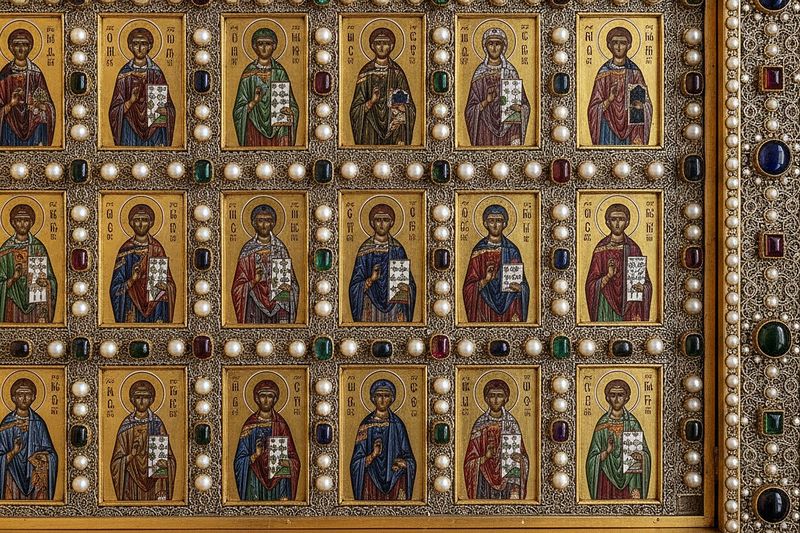
The Pala d'Oro is the gold altarpiece behind the high altar, 3.34 metres wide and 2.12 metres high. It holds about 250 cloisonné enamels on gilded silver, set with 1,927 precious stones and gems. The lower part goes back to Doge Ordelaffo Falier, between 1102 and 1118: Christ in majesty surrounded by the evangelists, prophets, apostles and archangels, with the Virgin, the doge and the Byzantine empress Irene below. The upper band, with the archangel Michael and six feast scenes, probably came from the Pantocrator monastery in Constantinople after 1204. The altarpiece took its present form in 1343 to 1345 under Doge Andrea Dandolo. The rules give you ten minutes in front of it; use them to find the small scenes of St Mark's life and the transfer of his body to Venice on the sides.
The museum and the horses
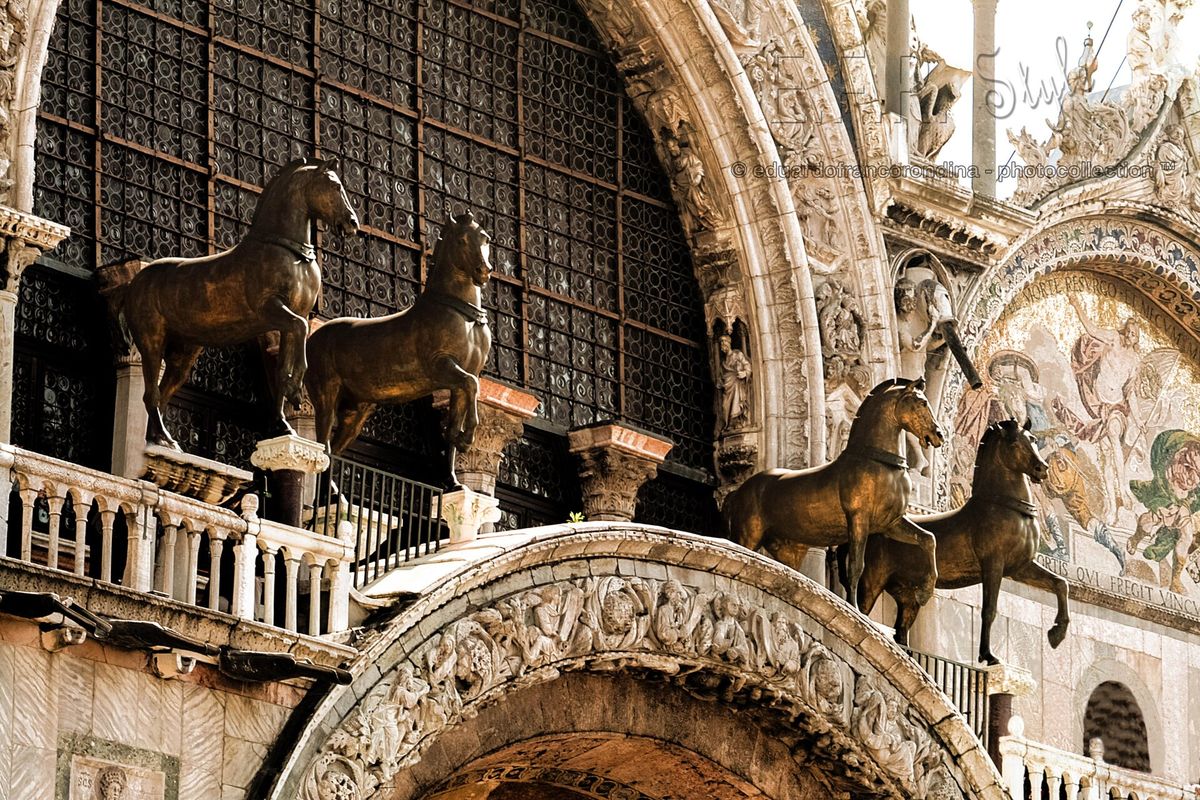
The museum occupies the rooms above the narthex and the doge's former banquet hall. Its star is the Quadriga, the four gilded bronze horses brought from Constantinople in 1204, taken to Paris by Napoleon in 1797 and returned in 1815. The horses you see outside on the facade are copies. The museum also shows Paolo Veneziano's Pala feriale, the painted cover that hid the Pala d'Oro on ordinary days, Persian carpets, tapestries of the life of St Mark and fragments of mosaics removed during 19th-century restorations. A lift and a stair-lift serve the museum for visitors with reduced mobility.
The Loggia dei Cavalli
From the museum you step out onto the terrace above the main portal, beside the copies of the horses. It is the best viewpoint over Piazza San Marco: the clock tower to the right, the Procuratie arcades on both sides and the Campanile in front of you. Children under 12 must hold an adult's hand here and pushchairs must be folded.
Guided visit or on your own
There are no labels on the mosaics and you cannot stop on the route for long, so a self-guided visit works best if you read up beforehand. A guide earns their fee here: they know which dome is which, where to stand and what you would otherwise miss. Groups larger than eight must use whisper headsets inside, so you can hear even in the crowd. Some tours combine the basilica with the Doge's Palace next door, which saves time on a short stay.
The bell tower
The Campanile across the square is 98.6 metres high. The original tower, begun in the 10th century, collapsed on 14 July 1902 and was rebuilt as it had been. A lift takes you to the bell chamber, where the view takes in the domes of the basilica, the whole city and, on clear winter days, the Alps. The ticket costs €15.
Frequently asked questions
What is the Pala d'Oro?
A gold altarpiece behind the high altar with about 250 Byzantine enamels and 1,927 gems, mostly from the 12th to 14th centuries. It costs €10 on top of the basic ticket.
Are the horses on the facade the originals?
No. The four originals are in the basilica museum; the horses on the terrace outside are copies.
Can I see the treasury?
The treasury is not listed as a separate ticket in the current price list. Check on the day whether it is part of your route.
Is the crypt open to visitors?
The crypt is shown on the guided evening visits for groups; it is not part of the standard daytime route.
Is the terrace worth it?
Yes, for most visitors. The view over the square from beside the horses is one of the best in Venice and the museum is included.